Manual Valves vs. Pneumatic Valves vs. Electric Valves: How to Choose
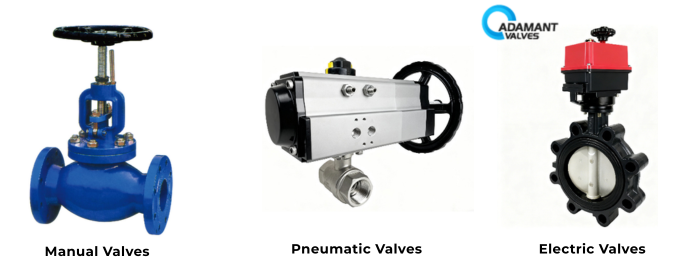
Manual Valves, Pneumatic Valves, and Electric Valves
Manual Valves are the most basic and traditional type. An operator turns a handwheel, lever, or gear. This mechanical action (via a stem, nut, etc.) moves the valve’s internal part (like a gate, ball, or disc) to open, close, or adjust the flow. Simple as that.
Pneumatic Valves run on compressed air. The air goes into a pneumatic actuator (common types are diaphragm, piston, and rack-and-pinion). This air pressure moves a piston or diaphragm, creating the force to turn or slide the valve stem and open/close the valve. They usually need a solenoid valve to control the air, allowing for remote operation.
Electric Valves are powered by electricity. An electric actuator (with a motor, gear set, control board inside) gets a control signal. The motor spins, gears reduce its speed and increase torque, and that turns the valve. This allows for precise control.
How to Choose
Q1: What’s the first big question I should ask?
Is automation your main need?
-
If the valve is rarely used, or just for maintenance/isolation, go with a manual valve. It’s the most cost-effective and reliable choice. No fancy systems needed, and upkeep is easy.
-
If you need remote or automatic control as part of a system, skip manual valves. Now decide between pneumatic and electric.
Q2: Okay, I need automation. Pneumatic or Electric?
It comes down to what you need the valve to do.
-
Situation 1: Quick on/off switching, or simple “open” and “closed” states.
-
Go with Pneumatic. Why? They’re super fast (like 1-3 seconds). Perfect for emergency shutdowns or frequent cycling. They’re simpler, so often cheaper and easier to maintain than electric valves for the same job.
-
-
Situation 2: You need precise control—to accurately adjust flow, pressure, or temperature.
-
Go with Electric. Why? Electric actuators can smoothly position a valve anywhere between open and closed using signals like 4-20mA. They’re way more precise and stable than pneumatics (which need add-on positioners and can be affected by air pressure changes).
-
Q3: What if the area has flammable gases or dust?
Safety is key here.
-
For simple on/off control: Strongly recommend Pneumatic. They use air, not electricity, so no sparks. They’re inherently safer in explosive atmospheres. You avoid costly explosion-proof ratings, making them safer and often more affordable overall.
-
For precise control: You must use an Explosion-Proof Electric Valve. Make sure its rating (like Ex d IIC T6) matches the hazardous area classification. Heads up: this significantly increases the cost.
Q4: What if my plant doesn’t have compressed air?
Think about the total cost of getting air to the valve.
-
If you have no air system, or running air lines is too hard/expensive, lean towards Electric Valves. Even if the unit price is higher, you save a ton on not buying air compressors, dryers, filters, and piping. The whole setup can be simpler and cheaper in the long run.
-
If you already have good, clean plant air readily available, then Pneumatics make more sense. Their speed, easier maintenance, and safety benefits really shine here.
Q5: What about maintenance and reliability?
-
Manual Valves: Easiest to maintain—basically just lubrication and occasional packing adjustment. Most reliable mechanically, but they depend on a person to operate them.
-
Pneumatic Valves: Maintenance is all about air quality. You must regularly drain water and filter the air to keep moisture and gunk out of the actuator, which causes corrosion and sticking. The actuator itself is tough.
-
Electric Valves: Most complex to maintain. They have mechanical, electrical, and electronic parts. Watch out for motor overheating, gear wear, circuit board issues, or sensor failures. You’ll need more skilled techs to troubleshoot and fix them.