Wafer Valves: The Compact and Efficient Solution for Flow Control
In industrial piping systems, valve selection directly impacts cost, efficiency, and reliability. Among various valve designs, the wafer valve stands out as an excellent solution for applications where space and budget are constrained, thanks to its unique design concept. This article will explore the key features, installation process, common types of wafer valves, and clarify the distinction between wafer and lug-style valves.
Key Features and Advantages of Wafer Valves
A wafer valve, as the name suggests, is a valve without its own flanges that is designed to be clamped between two pipe flanges. Its core design philosophy centers on “simplicity and integration.”
Main Characteristics:
- Compact & Lightweight: Its short length makes it quite light, and it is ideally suited for applications involving large numbers of pipes.
- No Integral Flanges: In this valve, the connection and sealing are done by the bolts coming from the neighboring pipe flanges.
- Cost-Effective: It saves cost compared to similar flanged valves because it eliminates the cost associated with valve body flanges. It also uses only half of what is required in other valves for bolting.
Primary Advantages:
- Conserves Space and Weight: Most useful in space-restrained situations such as ships, tall buildings, and small plants.
- Reducers Cost: Provides competitive procurement costs and minimizes the costs of installing materials.
- Installation Flexibility: Particularly suitable for “sandwich” installation between two fixed pipe sections.
How to Install a Wafer Valve
Proper installation is critical to ensuring the seal integrity and long-term reliability of a wafer valve. The process can be summarized as “Align, Insert, Tighten, Check.”
- The two pipe flanges must be positioned in a manner that ensures they are in line, parallel, and slightly wider than the thickness of the valve. The sealing surface on each flange, as well as on each valve sealing surface, must also be cleaned
- Mount the valve between the flanges with attention to aligning valve holes with flange holes. When orienting valves that depend on flow direction (such as check valves), great care is required.
- Position gaskets and insert bolts. The sealing gaskets must be positioned, typically on both sides of the valve. The bolts of proper Length must be inserted.
- Uniform tightening. Tighten all nuts evenly using a crisscross pattern. This is the most important step. Inconsistent tightening can cause uneven force on the valve, which can result in leaks, jamming, or even breakage.
- Check the operation of the valve after tightening by manually operating the valve (turning the butterfly valve handle) to ensure smooth opening and closing without binding. Conduct a system pressure test to check for leaks.
Installation Warning: The sealing of a wafer valve depends entirely on the flatness of the pipe flanges and the correct bolt torque. Insufficient pipe support, misaligned flanges, or improper tightening can easily cause leaks.
Common Types of Wafer Valves
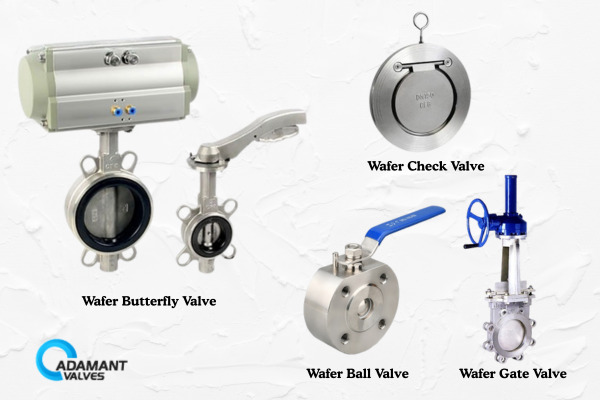
A wide variety of valve types can be made in the wafer pattern. These are most often:
- Wafer Butterfly Valve: It is used in the majority of installations. A thin disc is best suited for a wafer butterfly valve. Performing the functions of shut-off or regulation for water, air, or low-pressure gases/liquids in general industries.
- Wafer Check Valve: This type includes the wafer swing check valve and the dual plate wafer check valve. They are highly compact devices that function well to ensure backflow prevention.
- Wafer Ball Valve: Normally full-bore or V ported valves. These are used for applications that require a tighter closure/shut-off control, providing a substantially lighter alternative for flanged ball valves.
- Wafer Gate Valve: Relatively less used, often applied when there are significant space constraints. They provide minimal resistance to flow, but controlling the thickness of these valves becomes a critical task.
Wafer Valve vs. Lug Valve: The Key Differences
A lug-style valve is often confused with a wafer valve due to their similar appearance, but they function differently. Understanding this distinction is crucial for proper selection.
| Feature | Wafer Valve | Lug-Style Valve |
| Body Design | Smooth body with through-holes only. | Body has threaded lugs (ears) on both ends. |
| Installation | Requires one long bolt to pass through both flanges and the valve to clamp it. | Can be installed using long bolts like a wafer valve, or with short bolts to independently secure the valve to each flange. |
| Key Capability | Cannot be used as an end-of-line valve. | Can be used as an end-of-line valve, allowing for segment removal and easier maintenance. |
| Cost & Weight | Generally lighter and more economical. | Slightly heavier and more expensive. |
| Typical Use Case | Mid-line in piping, space-constrained, cost-sensitive projects. | Applications requiring potential single-end disconnection, or as an isolation valve at the end of a pump or tank connection. |
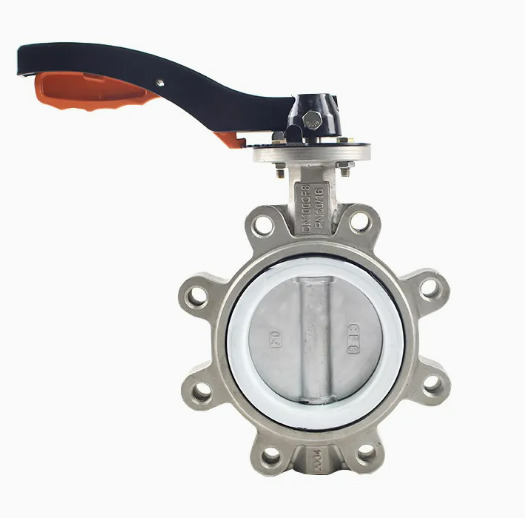
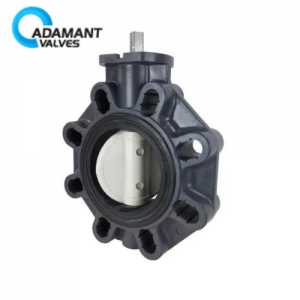
Lug Valve
Conclusion
An example of this philosophy can be found with wafer valves. By structural simplification, these devices achieve considerable savings regarding space and costs without reducing performance. In essence, the benefit potential of these devices is related to their integration or embedding within the piping system.
Wafer valve selection, however, is not always a universal selection. The best possible application for its usage has an immense dependence on properly aligned flanges for pipes. In cases of high vibration levels in pipes, improper pipe support, or frequent disassembly requirements, flanged/lug valves can be considered superior to other options.