Pneumatic vs. Electric Actuators in Pharmaceutical Manufacturing

In the pharmaceutical industry, particularly within GMP (Good Manufacturing Practice) critical zones, pneumatic actuation is the absolute mainstream and preferred choice. Electric actuation, on the other hand, is applied in specific non-critical or modulating scenarios.
Why Does the Pharmaceutical Industry Favor Pneumatic Actuation?
The dominance is rooted in its ability to meet the pharmaceutical industry’s most stringent demands.
1. Sterility and Cleanability
Pharmaceutical manufacturing, especially of parenteral drugs, requires an uncompromising commitment to sterility. Pneumatic actuators excel here.
- Contamination-Free Operation: Pneumatic actuators use clean, compressed air as their only power source, which eliminates the risk of microbial harborage sites. It also prevents the generation of particulates or lubricants from internal gears or motors. This is a critical factor in aseptic filling suites and sterile core areas.
- CIP/SIP Compatibility: Their design is simple and robust, and fully sealed, polished housings are allowed. These housings are built to endure high-temperature, high-pressure cycles, so they can withstand aggressive Clean-in-Place (CIP) and Steam-in-Place (SIP) procedures.
2. Inherent Safety and Reliability
- Fail-Safe Operation: This is arguably the most critical feature. Process safety often requires a valve to move to a specific position when utilities fail and must open or close automatically. Pneumatic actuators achieve this reliably with spring-return mechanisms. What’s more, they ensure a safe process state without external power that may increase risks.
- Explosion-Proof by Design: Many processes use flammable solvents. Examples include ethanol and isopropanol. Pneumatic systems are intrinsically safe and produce no electrical sparks. This removes the need for costly explosion-proof certifications that electric motors in hazardous areas require.
3. Regulatory and Validation Alignment
Pneumatic systems are simple, so they are easier to qualify and validate. Their operation is deterministic: Air goes in, and the stem moves out, which supports straightforward Installation (IQ), Operational (OQ), and Performance (PQ) Qualifications. Regulatory inspections, such as those by the FDA or EMA, view this favorably.
4. Performance and Maintenance
- Rapid Response: They provide very fast actuation, often taking less than one second. This is essential for quick isolation in processes like rapid transfer ports in isolators.
- Durability and Simplicity: They have fewer internal parts than electric drives. This results in a high mean time between failures. Maintenance is usually simple, and it typically involves replacing basic seals and checking air line filters.
Decision Framework and Best Practice
Electric actuators are not excluded but are strategically deployed in non-product contact, support utility systems, where their strengths are advantageous.
A standard decision tree used by process engineers and automation specialists in the U.S. pharmaceutical industry is straightforward:
Is the valve in direct product contact or within a GMP-classified cleanroom?
YES → Select Pneumatic.
Does the valve require a guaranteed fail-safe position for process safety?
YES → Select Pneumatic (spring-return).
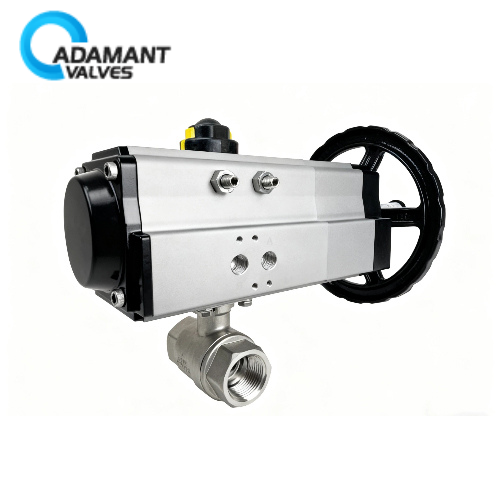
Pneumatic Spring Return Stainless Ball Valves (3 NPT)
Is the valve part of a CIP/SIP loop?
YES → Select Pneumatic with appropriate sanitary design.
Is the primary function modulation or positioning in a non-critical utility system?
YES → Electric is a viable candidate