Sanitary Valve Seal Materials Guide
In hygienic process industries such as food & beverage, pharmaceuticals, and biotechnology, valves are not just devices for controlling fluid flow—they are critical barriers that ensure product quality and safety. A minor seal failure can lead to contamination of an entire batch, production line shutdown, or even serious sanitary incidents. One of the key factors determining the sealing performance and reliability of valves is the choice of seal material.
Core Requirements for Seal Materials
In sanitary applications, seal materials are far from ordinary rubber. They must meet a series of stringent requirements.
- Excellent Chemical Compatibility: Must withstand process media (such as juices, acids, alkalis, cleaning agents, solvents) as well as aggressive cleaning and sterilization chemicals like caustics, acids, and hydrogen peroxide used in CIP/SIP processes.
- Broad Temperature Range: Must withstand both process temperatures and higher-temperature steam-in-place sterilization, often up to 121°C or higher for SIP.
- High Cleanliness & Compliance: Must be non-toxic, odor-free, and non-leaching, complying with regulations such as FDA, EU 1935/2004, and 3-A Sanitary Standards, with smooth surfaces that resist microbial growth.
- Outstanding Mechanical & Physical Properties: Including good elastic recovery (for effective sealing), resistance to compression set, wear resistance, and appropriate hardness.
- Processability & Cost-Effectiveness: Must be reliably processed into complex seal components (such as diaphragms, valve seats) and offer reasonable cost efficiency.
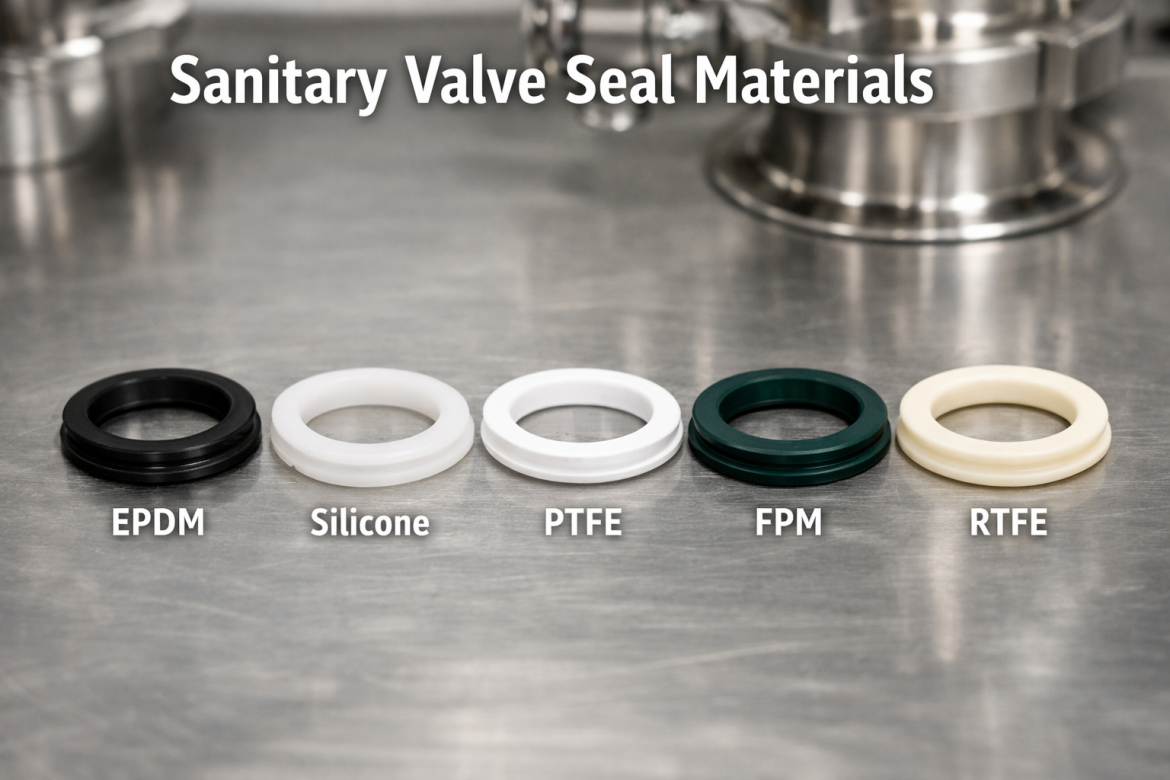
Based on these universal yet demanding requirements, EPDM, Silicone, PTFE, FPM, and RTFE form the primary matrix of sanitary valve seal materials. Each has its own strengths, together covering nearly all applications from general use to extreme conditions.
Available Seal Materials
1. EPDM (Ethylene Propylene Diene Monomer)
EPDM is one of the most versatile and cost-effective elastomers for sanitary applications. It offers excellent resistance to hot water, steam, dilute acids, alkalis, and alcohols. It is the ideal choice for systems requiring frequent CIP and SIP. Its good elasticity and mechanical properties ensure reliable dynamic and static sealing.
However, it performs poorly with oils, petroleum-based products, and most organic solvents, limiting its use in processes involving oils. In general piping systems for food and beverage (e.g., dairy, beer, juice), EPDM is the default material for valve seats, diaphragms, and seals.
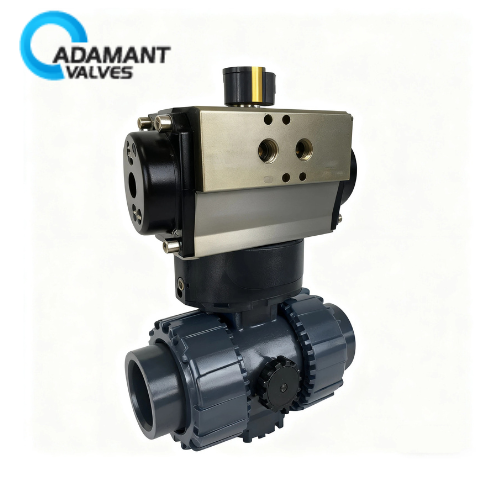
Air Actuated PVC Ball Valves – Rack & Pinion (4 NPT)
2. Silicone / VMQ (Silicone Rubber)
Silicone rubber is known for its exceptional temperature adaptability and high physiological inertness. It remains flexible across an extremely wide temperature range (-60°C to 225°C). It is virtually odorless and non-leaching, preventing product contamination. This makes it the gold standard in industries with the highest purity requirements, such as pharmaceuticals, biologics, and cell culture, especially for processes involving deep-freeze storage or high-temperature sterilization.
However, its mechanical strength is relatively low, and wear resistance is moderate. It also has limited resistance to high-pressure steam and strong acids/alkalis, so it is typically used specifically as a diaphragm material in controlled environments.
3. PTFE (Polytetrafluoroethylene)
PTFE, known as the “king of plastics,” offers unparalleled chemical inertness. It resists almost all known chemicals, including the strongest acids, alkalis, and solvents. It also has an extremely low coefficient of friction, excellent non-stick properties, and a smooth surface that is easy to clean with no dead spots. These characteristics make it the ultimate choice for handling highly corrosive chemicals, high-purity fluids (such as WFI), or media prone to crystallization or high viscosity.
PTFE also has drawbacks. Its main limitation is poor elasticity, requiring special designs (such as valve seats or linings) to compensate. Pure PTFE is also susceptible to “cold flow,” meaning plastic deformation under long-term pressure.
4. FPM / FKM (Fluoroelastomer)
FPM is a high-performance elastomer designed for demanding chemical and high-temperature environments. It offers excellent resistance to oils, fuels, most organic solvents, and strong acids at temperatures up to 200°C. It has high mechanical strength, good compression set resistance, and wear resistance. This makes it indispensable in pharmaceutical chemical processes, API synthesis, and applications involving oily or aggressive solvents.
However, it has poor resistance to strong alkalis (e.g., ammonia) and superheated steam, and it is relatively expensive. In sanitary valves, it is commonly used for O-rings, valve seats, and diaphragms exposed to harsh chemicals.
5. RTFE (Reinforced PTFE)
RTFE can be understood as an “enhanced version” of PTFE. It is modified by adding carbon, glass fibers, or other polymers (such as PEEK) to the PTFE matrix, significantly improving the mechanical shortcomings of pure PTFE. RTFE offers greatly increased creep resistance (reducing cold flow), wear resistance, dimensional stability, and compressive strength, while almost fully retaining PTFE’s excellent chemical inertness and temperature resistance.
Therefore, RTFE is suitable for applications that require PTFE’s chemical performance but involve severe wear, high mechanical loads, or demand longer maintenance-free service life. It is the solution for high-end applications requiring ultimate reliability and longevity, though it comes at the highest cost.
Quick-Reference Comparison Table
For easy comparison and decision-making, here are the core characteristics of the five materials:
| Feature | EPDM | Silicone | PTFE | FPM | RTFE |
| Chemical Resistance | Water, steam, dilute acids/alkalis; poor with oils/solvents | Broad temp., high physiological inertness; poor with strong acids/alkalis/steam | Strongest chemical inertness, resists almost everything | Resists oils, solvents, strong acids; poor with strong alkalis/steam | Similar to PTFE, extremely chemically inert |
| Temperature Range | -50°C ~ 150°C | -60°C ~ 225°C | -200°C ~ 260°C | -20°C ~ 200°C | -200°C ~ 260°C |
| Mechanical Properties | Good elasticity, wear resistance | Excellent flexibility, low mechanical strength | Poor elasticity, prone to cold flow, smooth surface | High mechanical strength, wear-resistant | Best: high strength, wear and creep resistance |
| Typical Seal Forms | Diaphragm, valve seat, O-ring | Mainly diaphragm | Valve seat, lining, packing, coating | O-ring, valve seat, diaphragm | High-performance valve seat, wear-resistant seals, lining |
| Sanitary Compliance | Excellent, fully certified | Optimal for ultra-high purity | Optimal, easy to clean, non-stick | Excellent | Excellent |
| Cost | Economical | Medium to high | High | High | Highest |
| Key Applications | General food & beverage piping, CIP/SIP | Pharma/biotech high/low temp processes | Highly corrosive media, high-purity fluids | Oily/solvent-based harsh chemical processes | Where PTFE performance is needed but with tougher conditions and longer life |
A Simple Summary
- If you need versatility and cost-effectiveness for water-based media with frequent steam cleaning, choose EPDM.
- For the highest cleanliness requirements, especially in pharmaceuticals and biotech, choose Silicone (mainly as a diaphragm).
- When handling highly corrosive or high-purity fluids without requiring elastic sealing, choose PTFE.
- For high-temperature oils, fuels, or organic solvents where elastic sealing is needed, choose FPM.
- When you need PTFE’s chemical performance but with higher mechanical strength, wear resistance, and long-term reliability, RTFE is the ideal choice.